A Structure Built to Win the Quote
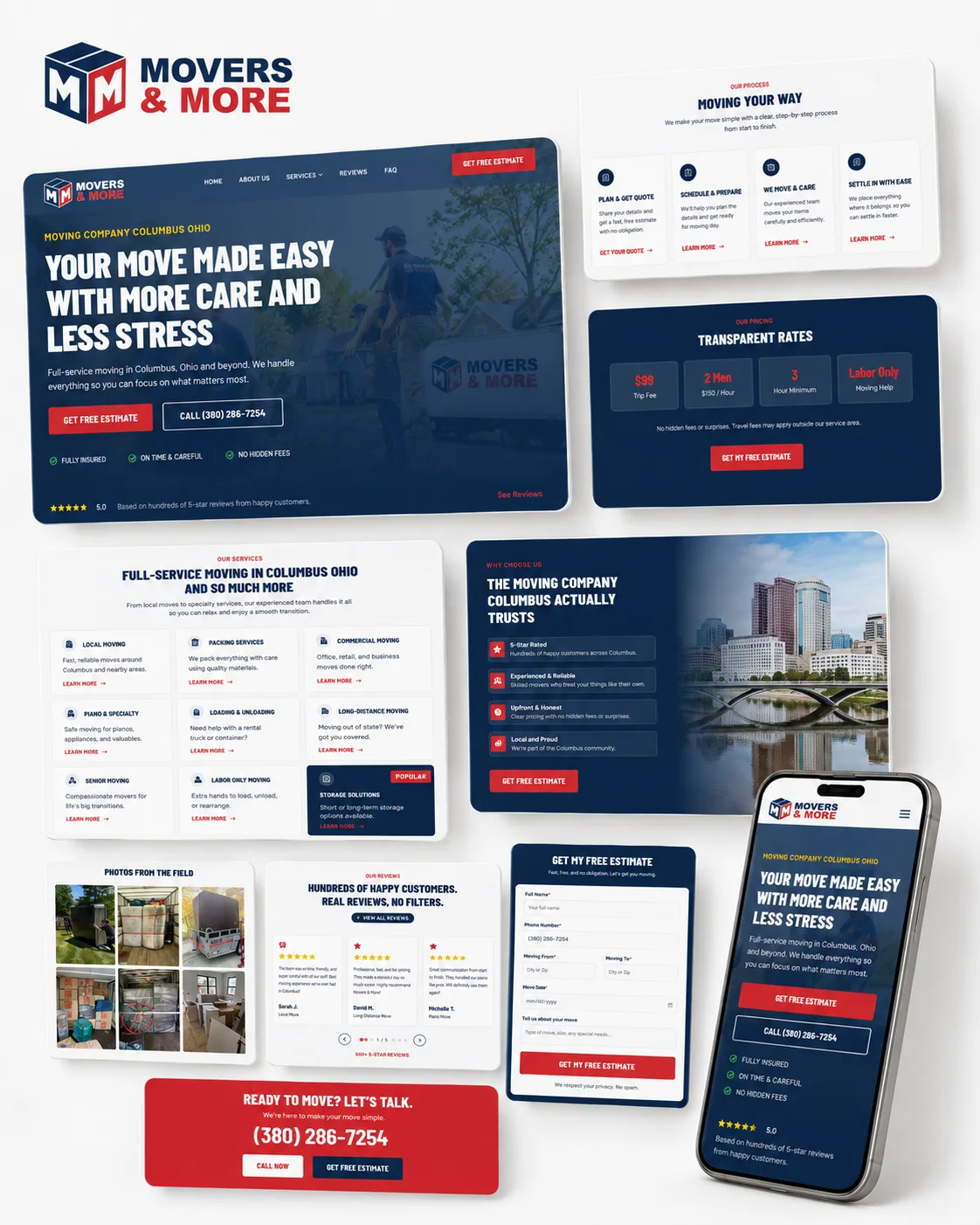
Movers and More
A live, ranking moving-company site in Columbus, Ohio, converting cold local-search traffic into phone calls and quote requests at a 4.67% visitor-to-inquiry rate — roughly double what a generic service-business homepage typically pulls. Here’s what’s behind that result, section by section.
Every Mover Says "Reliable." Almost None Say the Price.
Moving is a high-anxiety purchase made under time pressure, usually with three or four competitor tabs open at once. Most moving-company homepages fight that moment with a hero photo, a slogan, and a contact form buried below the fold — leaving price, the single biggest objection, unanswered until a phone call.
This site does the opposite. It puts a real number in front of the visitor within the first two scrolls, and it never asks for a commitment bigger than the one the visitor is ready to make at that point.
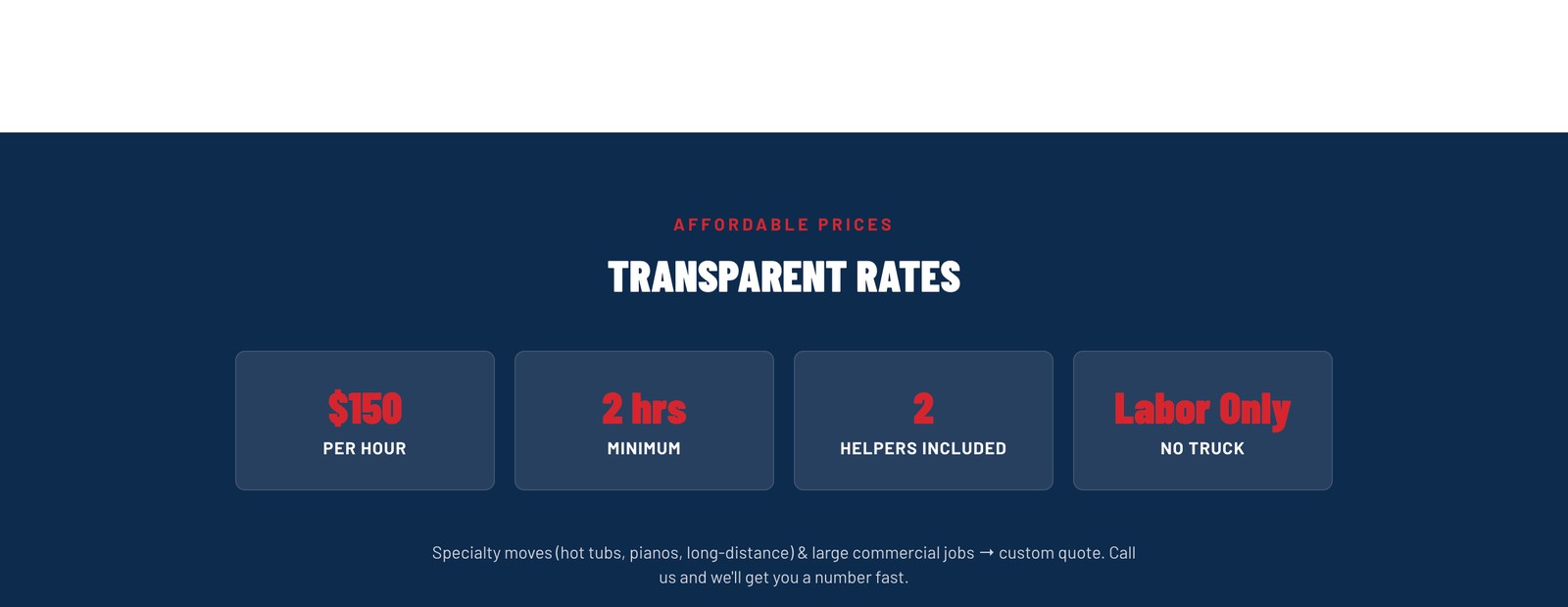
$150/hr, 2-Hour Minimum, 2 Helpers. Stated Plainly.
Immediately below the hero sits a navy band with the rate broken into four numbers: $150 per hour, a 2-hour minimum, 2 helpers included, and a labor-only rate for people who already have a truck. No "request a custom quote" wall, no email-gate. It's the second thing on the page, ahead of the services list, the team, and every testimonial.
This is a deliberate trade against the norm in the category, where hiding price is treated as a way to force a phone call. Here it does the opposite: it filters out visitors who were never going to convert (wrong budget) while removing the single largest source of hesitation for everyone else.
Trust Isn't One Section. It's Five.
Instead of a single testimonials block doing all the credibility work, proof is distributed across the entire page so no scroll depth is left without a reason to believe:
- Trust badges under the first CTA — Licensed, Insured, Locally Owned, Affordable Rates sit directly beneath the "Get My Free Estimate" button, answering the safety objection before the visitor even looks for it.
- A rating line before the first scroll ends — 4.8 stars, 200+ reviews, and one live quote, linked straight to the Google Business Profile. Third-party proof, not a claim the business makes about itself.
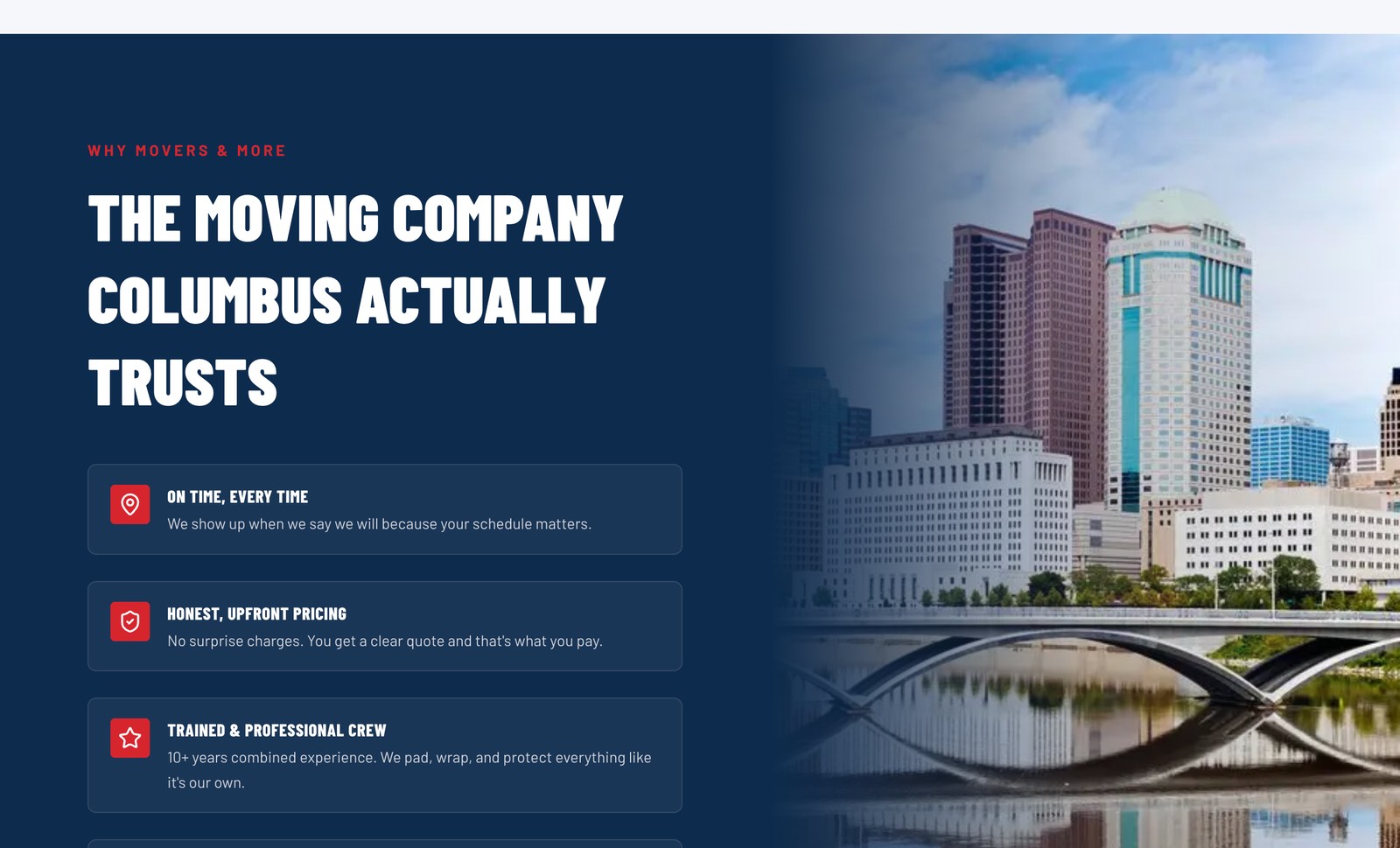
- A dedicated crew-trust section — four specific claims (on-time, honest pricing, trained crew, senior discounts), paired with a real Columbus skyline photo rather than stock imagery.
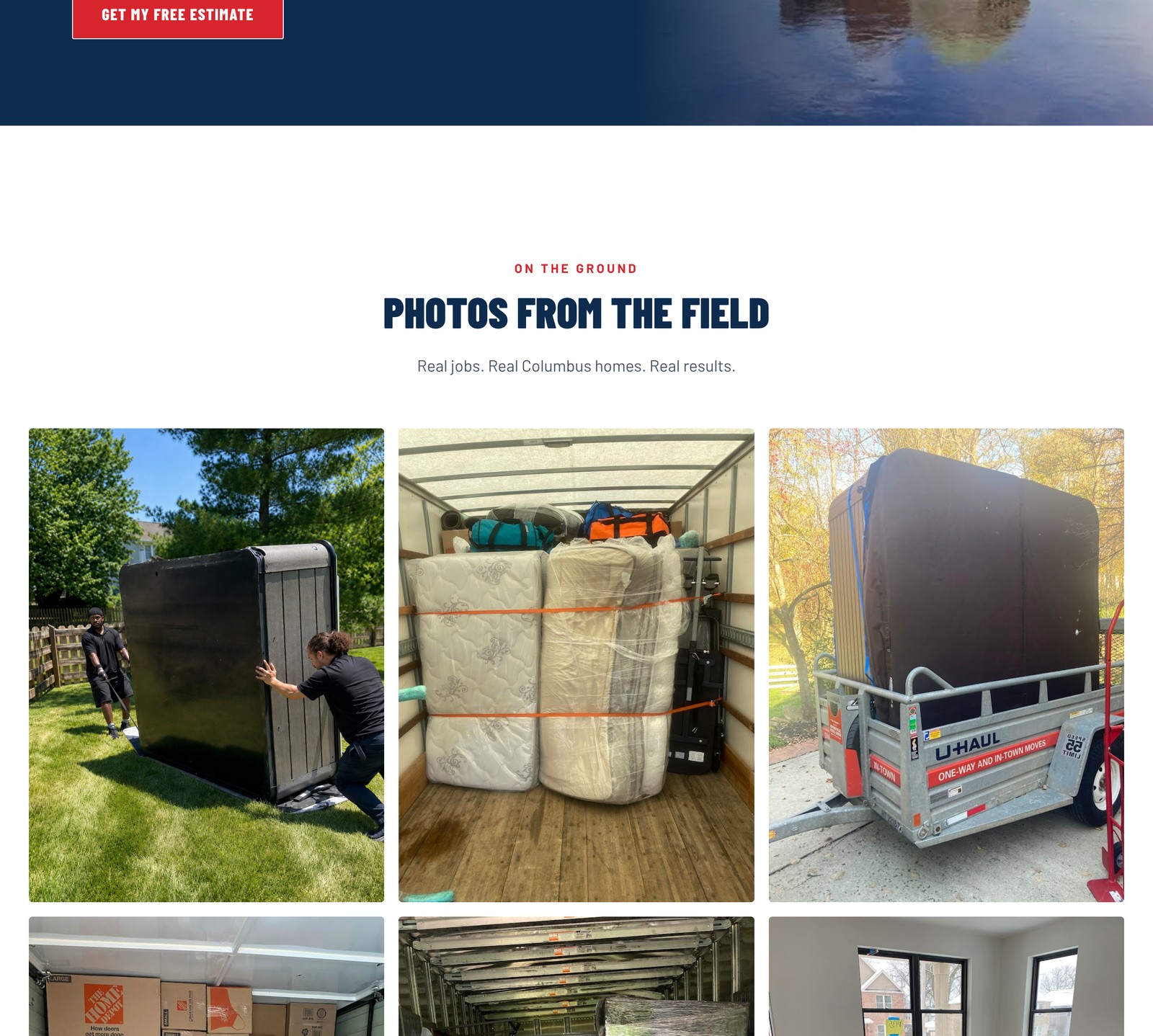
- Photos From the Field — a six-photo grid of actual jobs: wrapped mattresses, a hot tub on a trailer, boxes staged in a real living room. Evidence of care, not a description of it.
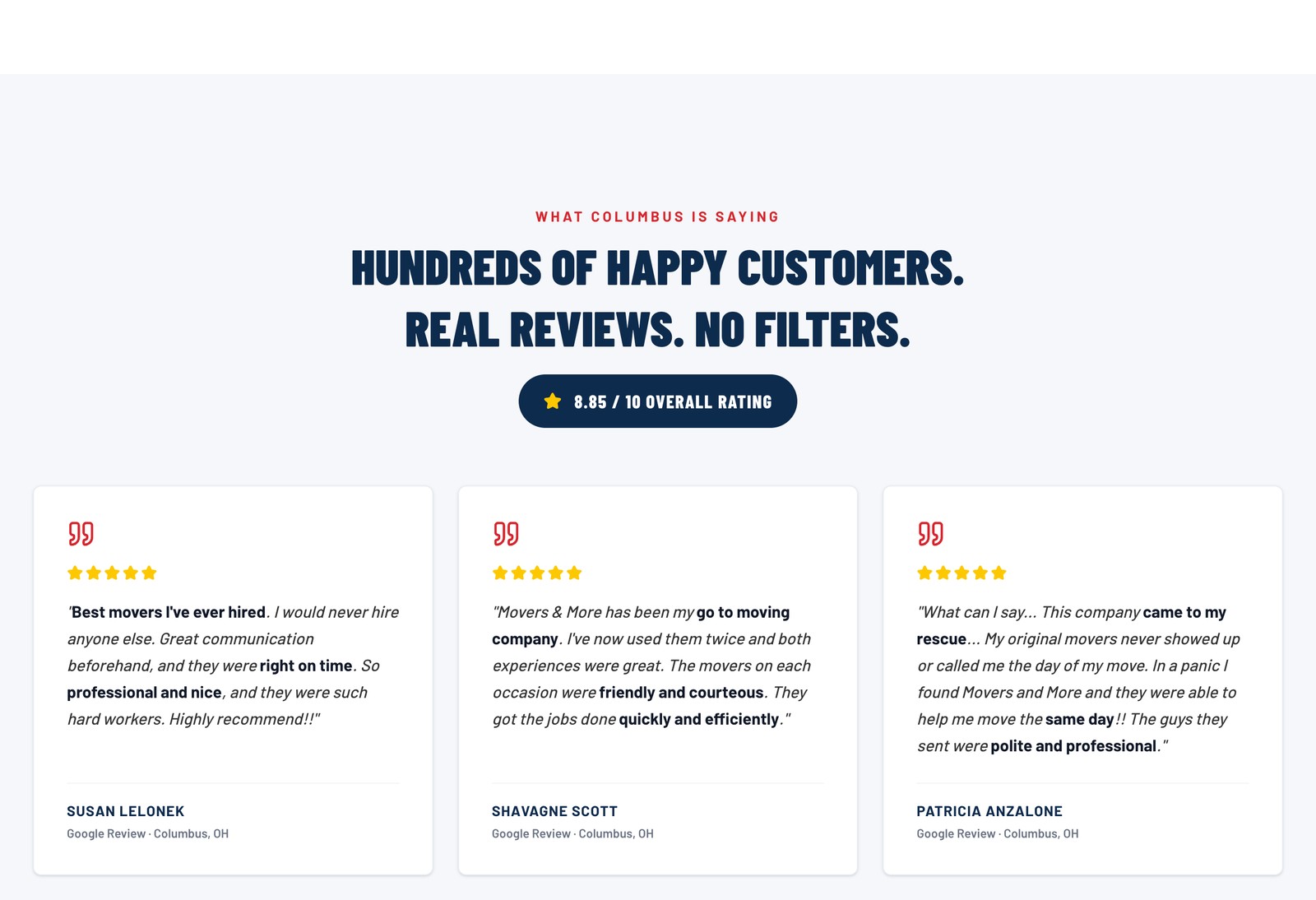
- A full reviews section — an 8.85/10 aggregate score plus three named, located reviewers (Susan Lelonek, Shavagne Scott, Patricia Anzalone), each tagged "Google Review · Columbus, OH."
By the time a visitor reaches the quote form, they've encountered proof five separate times without it ever feeling like a testimonials page.
Seven Chances to Convert, Each One Low-Friction
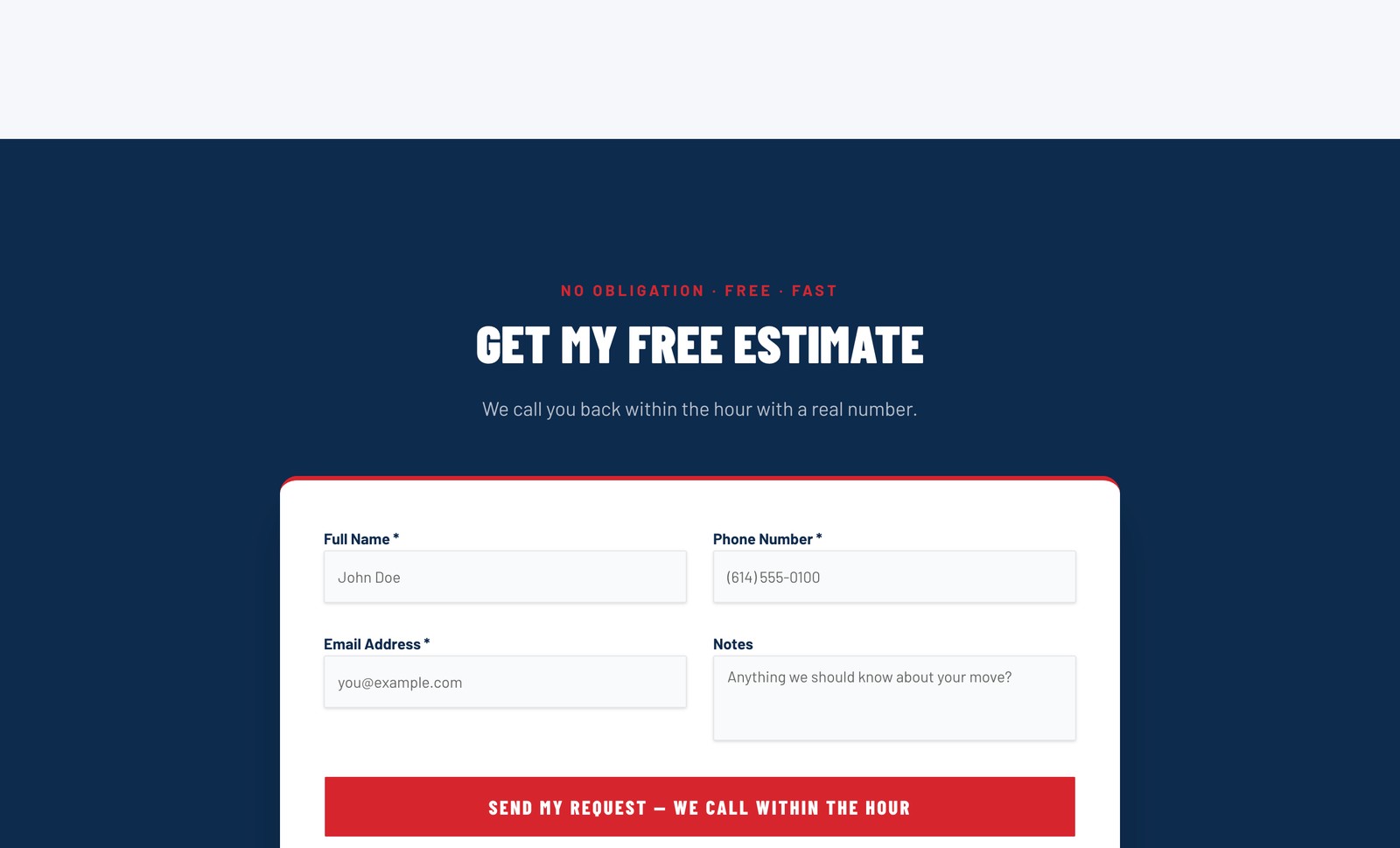
"Get My Free Estimate" appears at seven separate points down the page — hero, rates band, service picker, crew section, reviews, the dedicated form, and the closing band — so a visitor convinced at any point can act without scrolling back up. The form itself asks for four fields (name, phone, email, notes) and sets an explicit expectation: "We call you back within the hour with a real number." That line does two jobs at once: it lowers the perceived cost of filling out the form, and it pre-empts the anxiety that a lead-gen form disappears into a queue.
Want a site shaped around the questions your customers need answered before they get in touch? Let’s talk.
One Homepage Can't Rank for Twenty Searches. Twenty Pages Can.
The homepage targets "movers Columbus Ohio." It cannot also rank first for "movers in Dublin," "movers in Westerville," or "hot tub moving Columbus" — those are different searches with different intent, and Google treats them that way. This site handles it structurally instead of hoping one page does everything:
- Nine dedicated service pages — local moving, residential, commercial, packing & unpacking, long-distance, loading & unloading, senior moving, last-minute moves, and hot tub moving each get their own URL, each a landing target for its own keyword.
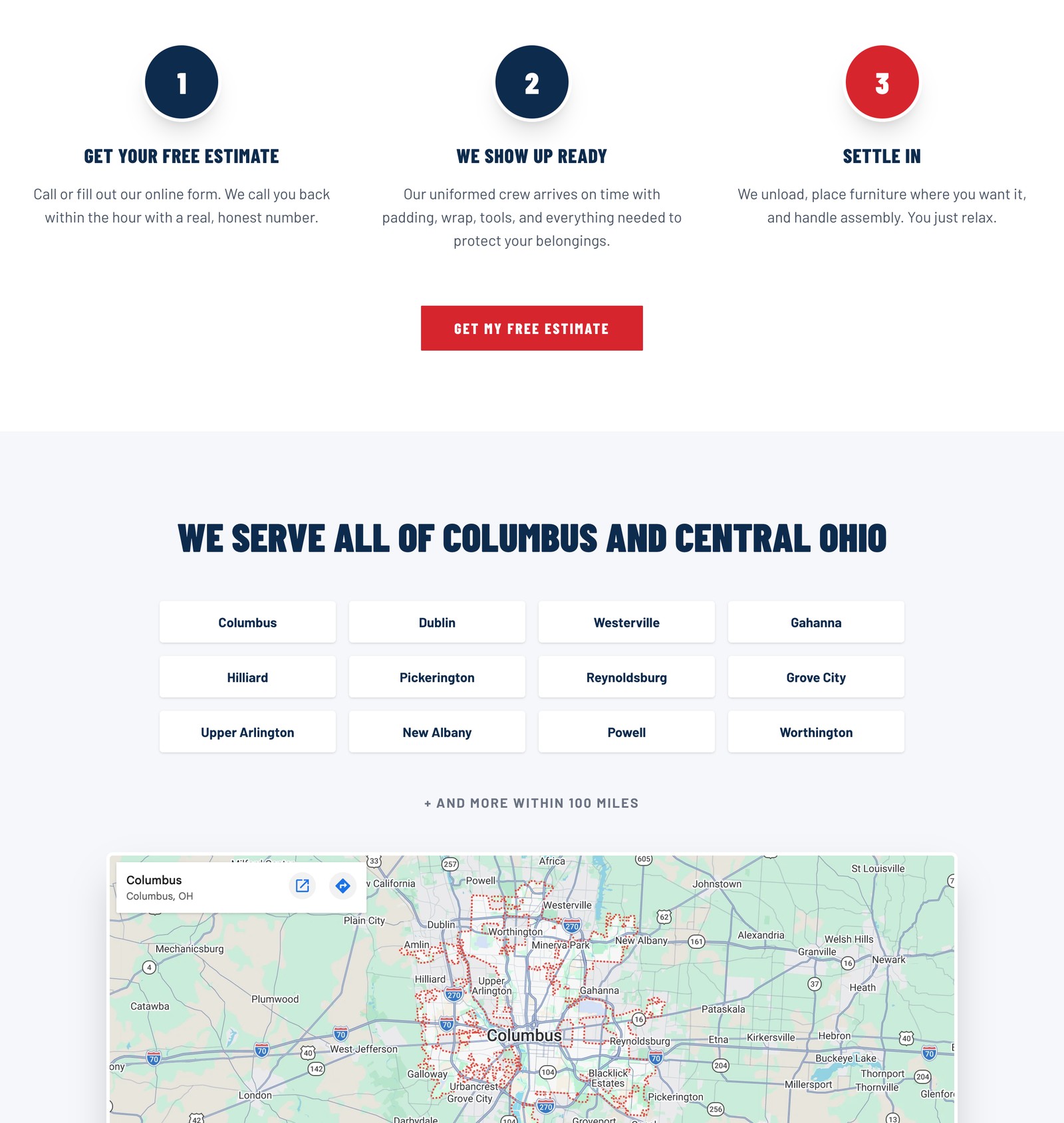
- Twelve named location pages — Columbus, Dublin, Westerville, Gahanna, Hilliard, Pickerington, Reynoldsburg, Grove City, Upper Arlington, New Albany, Powell, and Worthington are each linked by name from the homepage, with an embedded map reinforcing the service area visually.
- Consistent NAP — the same name, address (4606 Heaton Rd, Columbus, OH 43229), and phone number appear in the footer of every page, which is a basic but frequently-skipped local-SEO requirement.
Twenty-one indexable pages instead of one means twenty-one chances to be the first local result someone clicks, not one page competing against itself for every query at once.
Most Movers Search on a Phone, Mid-Panic.
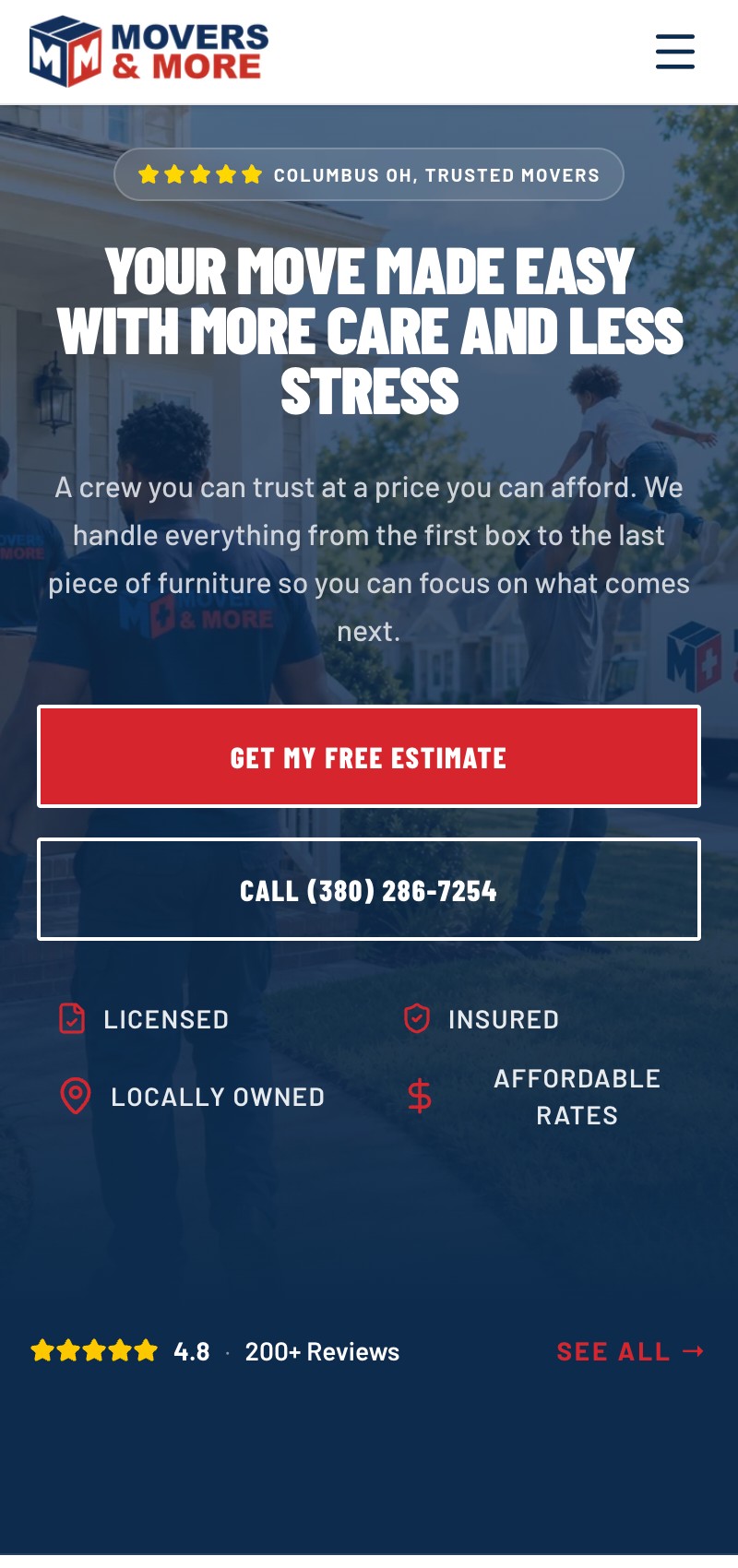
Local-service searches skew heavily mobile, and moving searches skew even further — often typed while standing in a half-packed room. Every structural decision above holds on a 390px screen: the rate card stacks to one column without losing the four numbers, the estimate form stays four fields, and the call button never scrolls out of reach.
- Tap-to-call and estimate button both above the fold
- Trust badges readable without pinch-zoom
- Rate card and reviews both survive the column collapse
None of This Is One Trick. It's the Compounding of Five.
No single section above accounts for a 4.67% inquiry rate on its own. Price transparency removes the top objection before it's raised. Proof distributed across five separate moments means credibility never runs out mid-scroll. Seven low-friction CTAs mean the ask is always one section away, never a scroll-back. Twenty-one indexable pages mean the traffic arriving is already close to a decision, because it searched something specific enough to land on a page built for it. And a mobile-first build means none of the above degrades on the device most visitors are actually using.
Individually, these are ordinary decisions. Combined and applied without exception across every page, they're the difference between a homepage that describes a business and one that's structured to convert it.
Let’s Build Yours Next.
Book a free discovery call. We’ll talk through how your site is structured and where it could serve your business better.